Screens
The owner's command surface.
Every clone runs inside the hospital, and these are the screens the hospital sees: the unit at a glance, the patient in one state, the note before signature, the receipt after it.

Synthetic data · real screens
Six instruments, one nervous system.
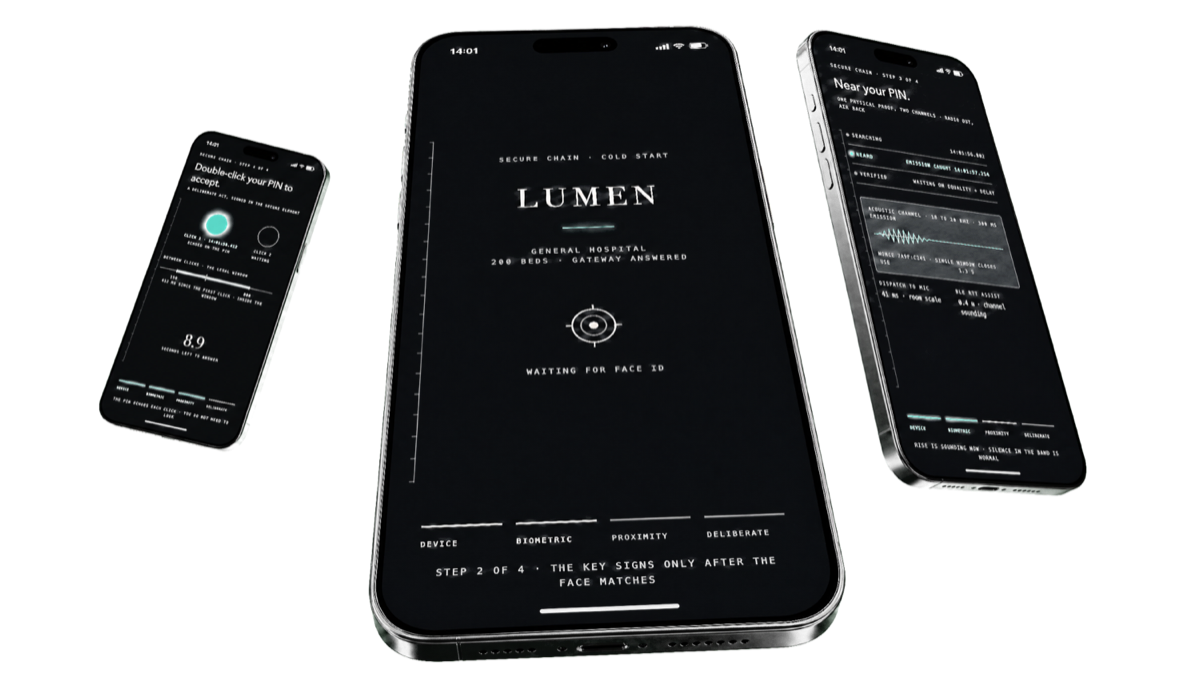
The chain, walked
The wordmark waiting on a face, the room answering at eighteen kilohertz, and the double click that has to land inside its window.
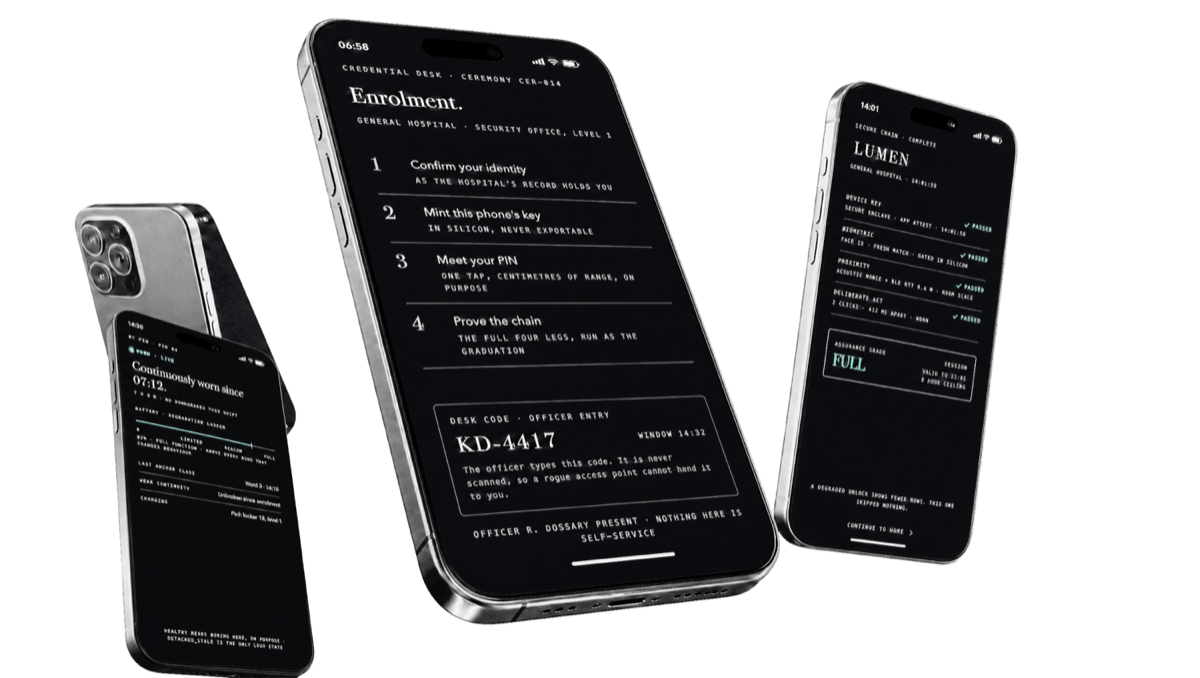
How a clinician is admitted
The credential desk, the four proofs stacking into one grade, and a PIN that has been worn continuously since the shift began.
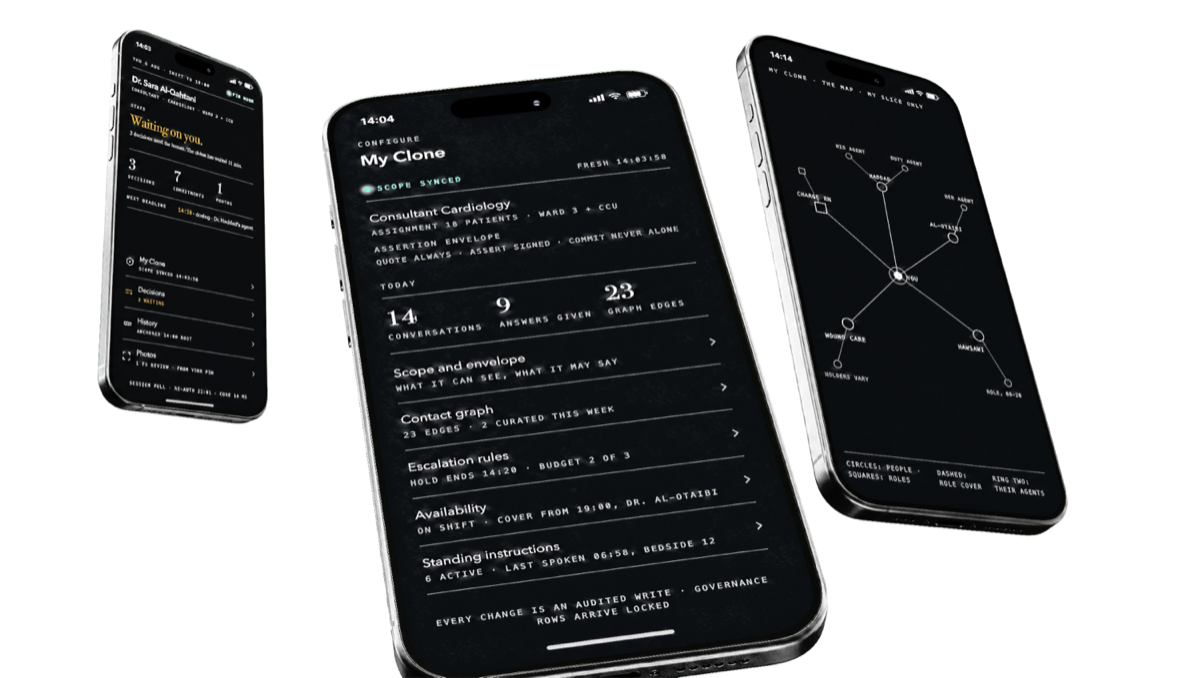
The clone, and its slice
One clone per clinician, the scope it may speak inside, and the part of the graph it can see. Never the whole hospital.
The unit board
The board ranks who needs eyes next, so a concern travels before an alarm has to. This is the owner's first screen of the day and the last one at night.
The specimen
The same complaint, three scripts.
أشعر بألم في صدري عند التنفس.
There is a pain in my chest when I breathe.
Une douleur dans la poitrine quand je respire.
The surface runs in Arabic, English and French, and Arabic is mirrored end to end, not translated in place. A hospital that works in three languages gets a nervous system that does too.
What the surface commands
See
The board ranks attention across the unit. A concern travels before an alarm has to, and the whole floor reads one truth.
Sign
The clone drafts, the clinician decides. Every clinical decision rises to a human signature, on every screen, without exception.
Keep
The audit chain is the hospital's property: append-only, rooted in its own machine room, portable on the day it asks.